Beyond the Famous Tombs: Deir el-Medina and Luxor’s West Bank
Discover why Deir el-Medina deserves a focused West Bank visit, from its workers’ community and decorated tombs to a thoughtful specialist route.



A first Luxor East Bank tour usually centres on Karnak and Luxor Temple. They can fit into a half or fuller day depending on your pace, guide depth, transport, and current access. Visit them as connected parts of ancient Thebes, but give each enough time to reveal its own scale, use, and relationship with the city.
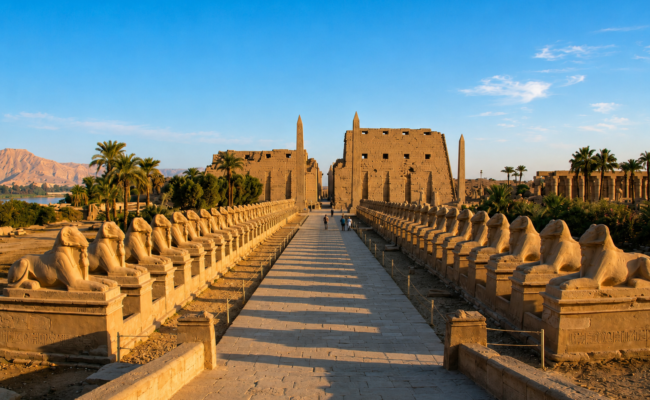
Karnak is a vast complex shaped by generations of building, ritual, and political ambition. Luxor Temple is more compact but deeply connected to kingship, procession, and the urban landscape. The ancient ceremonial route between them helps explain why this is more than a convenient two-stop itinerary.
A guide should build that relationship gradually. Ask for an explanation focused on a few architectural and historical themes rather than a stream of disconnected names and dates.
Karnak normally needs the larger share because of its scale, exposed spaces, and number of visual layers. Luxor Temple may take less time but deserves a deliberate circuit. Your total will also include hotel pickup, transport, security, ticketing, rest, and possible queues.
If you move slowly, photograph carefully, or need seating, plan a longer window. A rushed half-day is not automatically efficient if it leaves no margin for the conditions you encounter.
Daylight makes architectural forms and carved detail easier to read, while later light can change the atmosphere and temperature. Evening access may appeal to travellers who prefer a different visual experience. The right answer depends on official hours, lighting operations, seasonal sunset, special events, and your other plans.
The Karnak and Luxor Temple tour with sunset timing aims to connect those conditions when possible, but sunset colour, weather, access, and the precise sequence cannot be guaranteed.
Independent travellers can appreciate the architecture with good preparation and current site information. A guide adds value by showing how construction phases overlap, decoding selected scenes, and connecting the temples to the broader landscape. If you hire one, discuss depth, language, meeting point, and whether guiding is allowed throughout every area on your route.
The wider article on choosing an Egyptologist guide provides an interview checklist.
Expect substantial hard surfaces, uneven areas, thresholds, exposed courtyards, and distances that may feel longer in heat. Current accessible paths and facility conditions need direct confirmation. Ask where a vehicle can stop, whether a wheelchair can move through the intended circuit, where seating is available, and which areas can be omitted without breaking the visit.
Large halls and groups can also affect sound. Travellers who benefit from clear lip visibility or a quieter explanation should tell the guide before entering a crowded area.
Check current rules for cameras, video, tripods, and commercial equipment. Do not touch reliefs, cross barriers, climb stonework, or block routes while composing images. Ask before including staff, worshippers, workers, or other visitors in a close photograph.
A combined day works for travellers with limited time and a willingness to select highlights. Read the one-day Luxor itinerary before deciding. Separate days are better when you want deeper tomb and temple visits, specialist photography, or more rest.
The West Bank guide explains those route choices, while the first-time Luxor guide puts both banks in a wider stay.
Use the Luxor tours hub to compare a dedicated temple visit with a full-city day. Confirm pickup bank, private or shared basis, guide service, admissions, and the planned duration in writing. A good East Bank visit helps you understand relationships across space and time rather than simply moving between two gates.
A curated list of the most popular travel packages based on different destinations.

Discover why Deir el-Medina deserves a focused West Bank visit, from its workers’ community and decorated tombs to a thoughtful specialist route.

Choose a coherent Luxor West Bank route by balancing royal tombs, memorial temples, Deir el-Medina, ticket options, heat, and walking pace.

Plan a Valley of the Kings visit around current tomb access, ticket choices, heat, walking, photography rules, and realistic guide expectations.
Make one day in Luxor work by choosing a balanced East and West Bank route, with flexible options for pace, heat, transport, and deeper interests.

Understand Luxor balloon pickup, weather dependency, clothing, accessibility, operator questions, and cancellation terms before reserving a flight.
Orient your first Luxor visit across the East and West Banks, with guidance on trip length, transport, pacing, sunrise activities, and Nile connections.



